
Generative AI vs. Agentic AI: What's the Difference and Why Does It Matter?
While AI adoption of still varies by industry, it's become clear that businesses need it in today's fast-paced, data-rich world. We've all become familiar with generative AI models like ChatGPT and Google Gemini, but agentic AI is another emerging technology that shows significant promise.
Our guide explains everything you need to know about generative AI vs. agentic AI and how each technology fits your goals. That way, you can choose the right tools for creating better customer experiences.
What Is Generative AI?
Generative AI creates new content—such as images, text and audio—by learning patterns from massive volumes of data. Some popular examples of generative AI include:
ChatGPT
Google Gemini
DALL-E
Runway
Claude
Many software platforms now embed generative AI capabilities to help create visuals, draft reports and produce other useful documents for business operations.
What Are the Key Features of Generative AI?
The primary goal of generative AI models is content generation, whether their focus is creating images, videos or simple text responses. Many generative AI models can create a variety of content types For example, Meta AI can produce images, chat with users and create written copy for ads and blogs.
What Is Agentic AI?
Unlike generative AI, agentic AI focuses on performing multi-step tasks with minimal human oversight or assistance.
Agentic AI adapts dynamically to the circumstances it faces, making it a strong fit for complex applications. Customer service is an excellent example. Gartner experts predict agentic AI will autonomously resolve 80% of common customer service issues by 2029—a potential step-change in reducing customer care costs while improving the experience.
Some other examples of agentic AI applications:
Autonomous vehicles
Business intelligence platforms
Drone delivery
Advanced cybersecurity platforms
Predictive maintenance
What Are the Key Features of Agentic AI?
These features of agentic AI differentiate it from other AI types:
Autonomy: An AI agent can perform complex tasks completely on its own, without any prompting or oversight from human users.
Adaptability: Agents can learn from their environment in real time and adapt their decisions accordingly to ensure their task gets done.
Goal orientation: Agents can use the information in their training datasets to determine the most appropriate ways to achieve their objectives. They can also use this data to set goals for themselves, which can help ensure continuity.
While some of these capabilities are shared with generative AI, agentic models can be more dynamic in achieving their objectives. When an unexpected challenge appears, for example, an agentic model can adapt and problem-solve in real time—a capability that generative AI typically lacks.
Agentic AI and Generative AI vs. LLMs
How are generative and agentic AI models related to large language models (LLMs)?
LLMs are a subset of generative AI focused on text-based tasks. LLMs operate primarily through pattern recognition and massive datasets that provide context for those patterns.
Agentic AI isn’t an LLM. What makes agentic AI unique is its ability to autonomously plan, execute and adapt actions to achieve specific goals. It can use an LLM or network of LLMs for the reasoning stage in this process; then it plans and acts to complete task. Conversational AI vs. Generative AI
Conversational AI is an application of LLMs designed for dialogue. These models are specifically trained and tuned for interactive conversation, so users can request specific outputs without needing to remember extensive prompt engineering or precise phrasing.
Think of support chatbots on a company website. You input your question, and the chatbot interprets your words to provide a solution or answer in natural human language. While not all generative AI features conversational capabilities, most do.
Agentic AI vs. Generative AI: Which Is Right for Your Business Goals?
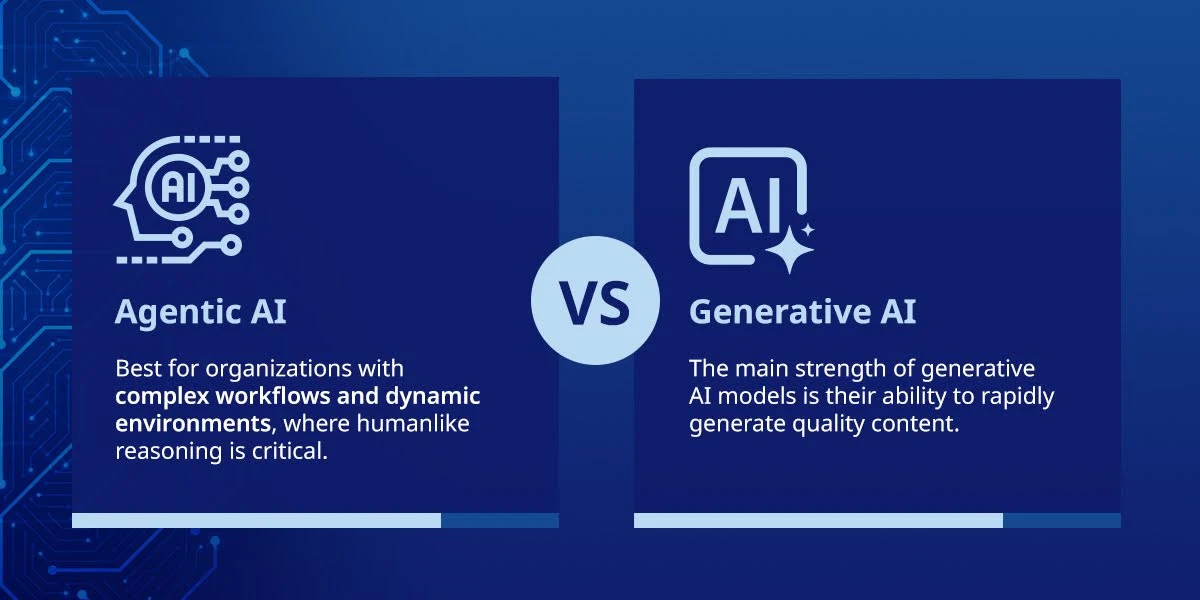
Understanding the differences between agentic and generative AI can help your company decide which technology to invest in.
Consider Generative AI If You Need:
Fast, on‑brand content for marketing, service and operations
Scalable drafting and summarization to speed decisions
Visualization and reporting from structured inputs
While this technology can handle a wide variety of tasks, it's essential to consider the limitations of generative AI and how they may play into your operations.
Most generative AI models are dependent on the data they're trained on. If any information is missing from that dataset, the AI can't search for an answer from outside sources. That said, developers are currently investing in ways to resolve this issue to ensure more useful outputs.
Consider Agentic AI If You Need:
Multi‑step workflows that adapt to change
Task automation that coordinates tools and data
Always‑on assistance that follows through to resolution
Agentic AI is best for organizations with complex workflows and dynamic environments, where humanlike reasoning is critical for business continuity. For example, self-driving vehicles need to be able to react quickly to other drivers to keep their passengers safe.
While agentic AI is still new to the market, it can significantly boost efficiency and customer service by enabling business continuity when disruptions occur. For example, a customer may need to consult your customer service department for assistance with a purchase.
An agentic AI program can help them navigate the support workflow without impacting the customer experience. Communicating with the customer like another human is key, and a suitable agentic model is an excellent way to provide that experience.
If you’re comparing agentic AI vs generative AI, ask: Do we mostly need content generation, or autonomous task completion? When in doubt, consider combining both: use an LLM for language and an agent to plan and act.
AI is transforming industries, and agentic AI will drive even greater change in the next few years. If your business needs to boost efficiency, fill talent gaps or just stay competitive, now is the time to explore new AI solutions.