
How to Evaluate CCM Vendors: What Buyers Can Learn From the QKS SPARK Matrix 2026

If you're assessing customer communications management (CCM) software, you've probably noticed a common problem: most vendors sound remarkably similar.
Nearly every provider talks about AI, omnichannel delivery, personalization, and compliance. But not every platform can support the complexity of a large enterprise environment, where communications span channels, systems, business units and regulatory requirements. That's much harder to discern before implementation (and expensive to discover after).
Independent analyst research can be helpful as you distinguish between CCM providers. The QKS SPARK Matrix™: Customer Communications Management, Q3 2026 digs past vendor marketing to assess providers on what they can deliver, and along the way, it maps out where the customer communication management software market is headed.
I'll walk through some highlights of what QKS uncovered and add our own recommendations on what should shape your CCM shortlist.
How to Read the SPARK Matrix (and Why)
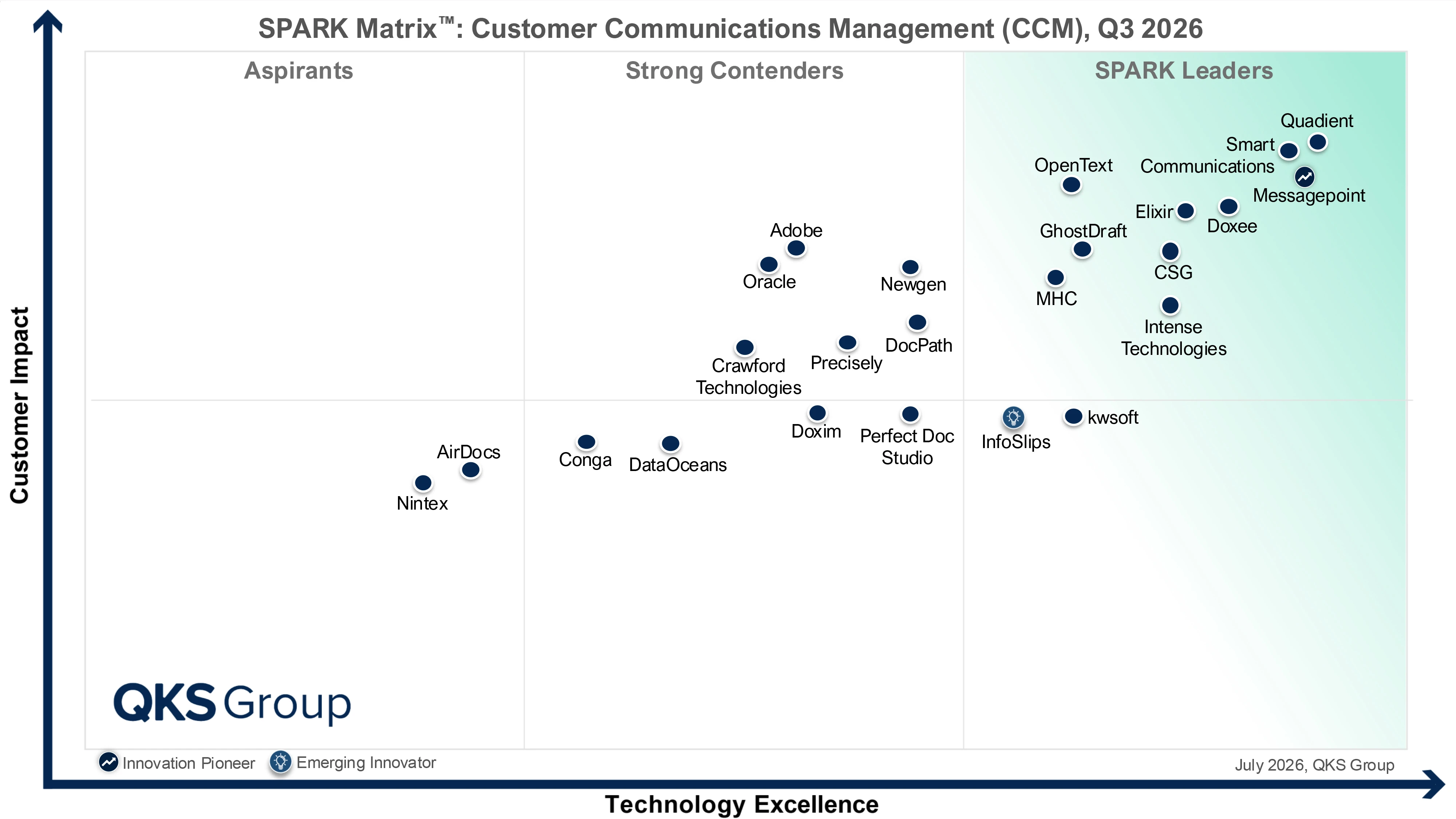
QKS Group (formerly Quadrant Knowledge Solutions) benchmarks vendors across two dimensions: Technology Excellence and Customer Impact. Technology Excellence looks at whether a platform can handle enterprise complexity, including content management, personalization, integration, governance and scalability. Customer Impact looks at the results a platform helps organizations achieve: business value, customer outcomes and fit across different use cases.
QKS defines a CCM platform as one that enables organizations to "efficiently create, manage, and deliver personalized, consistent communications across multiple channels throughout the customer lifecycle," with the goal of enhancing the customer experience, ensuring regulatory compliance and unifying what is often a fragmented, manual process.
Viewed together, those two axes give buyers a sense of where the best customer communications management software providers are investing, and which capabilities are becoming table stakes versus true differentiators.
Here’s how QKS positioned vendors on the SPARK Matrix for Customer Communications Management, Q3 2026, with CSG as a Leader in the top-right section:
RELATED ARTICLE: How to Cut Through ‘AI-Powered’ Claims in Customer Journey Management Using the QKS AI Maturity Matrix
3 Takeaways From the QKS SPARK Matrix for CCM 2026
The SPARK Matrix does more than evaluate vendors. It analyzes a handful of shifts reshaping the customer communication management software market this year. I'll highlight three that stood out to us as most consequential, along with what we think each one means for buyers.
AI Is Becoming Part of Everyday Communication Work
Across the report, QKS evaluates capabilities like content intelligence, personalization, customer engagement, and workflow automation, and it points to generative AI, predictive analytics and intelligent automation increasingly running underneath all of them. In other words, AI isn't just a bullet point on a slide anymore—it's now baked into how communications get built, personalized, and sent.
Our view: This tracks with what we're seeing directly from consumers, and it comes with a caveat worth building into any AI strategy. Our banking customer research found that comfort with AI splits sharply depending on whether it's informing or acting: 36% of banking customers are fine with AI delivering fraud or security alerts, but that comfort drops to just 19% once AI is the one submitting a payment on their behalf. That's a strong argument for AI that does more than generate content faster. It should also help decide what to send, to whom, and when to hold back, while keeping any action step explicit and confirmable rather than automatic. When you're evaluating vendors, ask what specific job the AI is doing (drafting content, classifying intent, flagging fraud) and how those outputs are reviewed before they reach a customer.
Governance and Compliance Are No Longer Secondary Considerations
QKS evaluates governance throughout the SPARK Matrix rather than treating it as a single, standalone category. Content management, workflow controls, and auditability show up alongside personalization and customer impact, and QKS explicitly names regulatory compliance as a core objective of CCM (not an add-on).
Our view: As communications spread across more channels and more teams, keeping them accurate and compliant becomes more complex. That's especially true anywhere AI is involved in drafting or personalizing content. In our experience, the platforms that shine under scrutiny are the ones where every AI-assisted output (whether it's a personalized payment reminder or a fraud alert) still runs through defined approval workflows, audit trails and human review before it reaches a customer. We agree that governance shouldn't be something you bolt on after AI adoption, but woven into the same system that's generating and delivering the message.
The Market Is Focusing More on Operational Fit
Some of the highest-weighted areas in this year's report include integration, workflow management, personalization, variability management, and migration from legacy environments. QKS is explicitly evaluating how well vendors support enterprise requirements across complex, already-built-out technology environments.
Our view: This is worth paying attention to because these capabilities rarely make the highlight reel in a sales presentation, but they're often what determines whether an implementation succeeds. A CCM platform doesn't operate in isolation—it has to work with the billing systems, CRMs, and service platforms you already have. We've seen this firsthand with a retail credit provider that unified more than 30 data sources, processing 167 million records daily, to power more consistent collections and payment communications without ripping out its existing stack. That kind of overlay integration (rather than a full replacement) is often what separates a platform that adds value in month one from one that takes a year (or longer) to show results.
RELATED ARTICLE: What It Takes to Connect Your CX Tech Stack: Perspectives From the Field
What to Look for in a CCM Platform: Our Recommendations
Whether you're building a shortlist or narrowing one down, here's where we'd recommend focusing your evaluation, based on what QKS is measuring and what we've seen determine success after go-live:
Integration depth. How does the platform connect to the systems of record you already run? What does implementation really look like inside a complex enterprise stack (and not just a demo environment)?
Governance and auditability. How are content changes reviewed and approved, and what audit trail exists across the full content lifecycle (especially for anything AI-assisted)?
Omnichannel coordination. Going beyond how many channels a platform supports, can the platform prevent duplicate or conflicting messages across them?
Purpose-built AI. Which AI use cases are live today (not roadmapped)? How are outputs governed, and where does human review remain in the loop?
Outcome measurement. Can you tie communication performance to business results, like payment completion or reduced call volume, by journey and segment, and not just delivery statistics?
CSG Named a Leader in Customer Communications Management
In this year's SPARK Matrix, QKS positioned CSG as a Leader in customer communications management software, based on its assessment of our Technology Excellence and Customer Impact. We'd say the same thing about any analyst recognition, including our own: Treat it as one data point in your evaluation, not a stand-in for hands-on testing. QKS's recognition centers on how CSG puts AI to work—not just for drafting content, but for the ability to make decisions in the middle of a live customer journey.
Here's how Saurabh Raj, Principal Analyst at QKS Group, explained it:
CSG stands out for moving AI beyond content assistance and embedding it directly into live customer journeys. Its AI agents support use cases such as payment reminders, intent classification, content generation, and fraud identification, supported by governance controls and a multi model architecture. This gives enterprises a practical foundation for using AI to improve decision speed.
That's where we believe AI is making the biggest difference in CX right now: helping organizations respond to what customers need in the moment, adapting journeys as conditions change, and delivering better experiences across millions of interactions.

Related Resources

Earning Renewal Through Clearer Insurance Communications

Print and Mail Vendor Migration: Why Staying Put May Be the Bigger Risk

AI-Driven Closed-Loop Journey Management: A Practical Buyer’s Guide