
The Omnichannel Customer Journey: Go Beyond Mapping to Orchestration

Customers expect every interaction to connect. It’s as simple as that.
If their journey starts on a website, shifts to a mobile app, and ends with a support agent, customers want to feel they’re understood and moving forward at every step.
Of course, that’s not simple to deliver. Organizations have invested in more channels, but the experience still falls apart when customers switch among them.
In this guide, I’ll explain what an omnichannel customer journey is and how it differs from multichannel (a very common point of confusion). Then I’ll lay out the stages and real-world examples of omnichannel customer journeys.
Finally, you’ll see how to go beyond journey mapping into journey orchestration: the real-time discipline of guiding customers across channels using unified data, decisioning, and coordinated delivery.
What Is an Omnichannel Customer Journey?
An omnichannel customer journey is the end-to-end experience a customer has with a brand across every touchpoint—before and after purchase—designed as one connected journey where context carries forward across channels.
Omnichannel journeys unify the data and the experience, so customers can jump from one channel to another without starting over or receiving conflicting messages.
Omnichannel vs. Multichannel: What’s the Difference?
Dimension | Multichannel | Omnichannel |
Channel integration | Channels operate independently | Channels are interconnected and coordinated |
Data sharing | Limited or siloed data sharing | Shared customer data and context across channels |
Customer experience | Customers often restart when switching channels | Customers pick up where they left off |
Focus | Brand presence on many channels | Unified customer journey across channels |
Organizations using a multichannel strategy try to increase their reach by adding channels, while an omnichannel strategy focuses on connecting those channels into a single experience.
Connected vs. Disconnected Journey: A Real-World Example
Consider a post-paid wireless customer who gets a data overage alert: Their teenager’s line on the family plan used more data than expected. In a connected journey, the customer opens the carrier app, sees the alert tied to that specific line, and gets a clear recommendation to upgrade only that line. A follow-up text confirms the new price and effective date, and when the customer starts a chat later to ask about hotspot data, the agent already knows what changed and why.
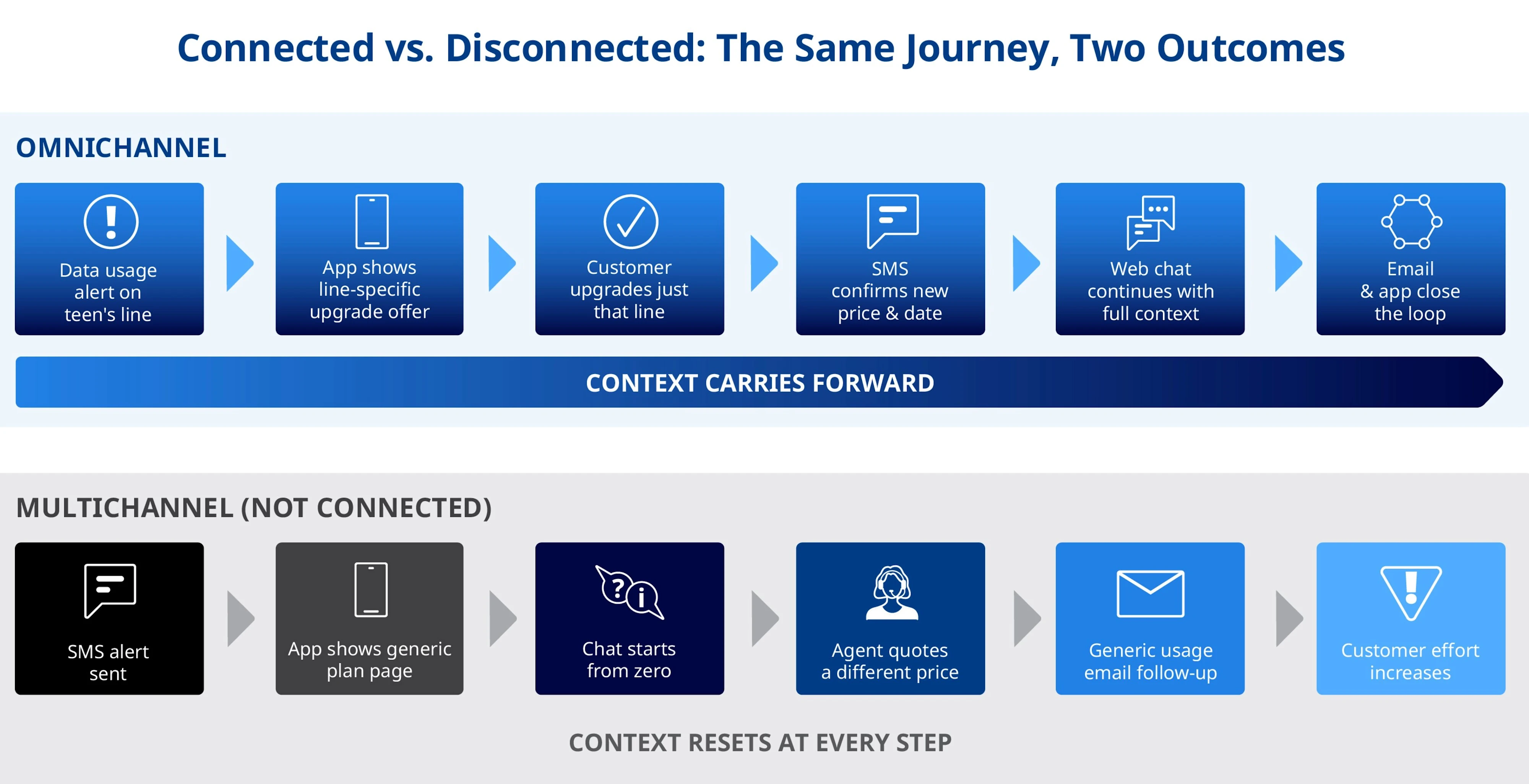
That’s what an omnichannel journey looks like in practice. The customer moves across app, messaging, and chat, but the experience doesn’t reset. Each interaction picks up the context from the one before it, so the next step feels relevant and consistent.
Now compare that with a multichannel journey that isn’t connected. The customer gets the same alert, but the app only shows a generic plan page. The chat starts from zero understanding. The live agent asks the customer to repeat the issue and quotes details that don’t match what the customer already saw. A later email ignores the change entirely.
Both journeys use multiple channels. Only one feels like a single experience.
Why the Omnichannel Customer Journey Matters: The Business Case
Omnichannel used to be a differentiator. Now it’s a baseline expectation for how customers interact with your brand. Brands with advanced personalization capabilities are 71% more likely to report improved customer loyalty, and brands that excel at personalization are 48% more likely to exceed revenue goals than brands with low personalization maturity. The cost of getting omnichannel wrong is straightforward, too: Disjointed journeys drive up avoidable service volume and churn risk.
Deloitte Digital reports that four in five companies have activated a channel-steering strategy to guide customers to the most appropriate channel for their inquiry. That same study also found that organizations implementing omnichannel integration tools reported a 9% lower cost per assisted contact.
Related Video: Omnichannel Solutions for Smarter Customer Care: Harnessing AI and Data
The Core Components of an Omnichannel Customer Journey
An omnichannel customer journey works when the experience is designed as a system rather than a set of disconnected campaigns. Here are the five attributes that define a true omnichannel customer journey.
Consistency
Customers should receive the same essential information and policy clarity across channels. Consistency reduces confusion and prevents customers from getting different answers depending on where they ask.
Seamlessness
Channel handoffs should preserve context: what the customer did and what the customer is trying to accomplish. Seamlessness is most visible when a task starts in self-service and ends with assisted support, with no need to repeat details.
Personalization
Personalization means tailoring messages, offers, and support based on customer context, not just a name field.
Convenience
Customers should be able to choose the channel that fits the moment. Convenience also means eliminating unnecessary steps and duplicate forms.
Technology integration
Omnichannel journeys depend on integrated systems: shared customer profiles, connected engagement tools, and coordinated decisioning.
The Five Stages of the Omnichannel Customer Journey
In real life, a customer journey rarely follows a straight line. Still, an effective omnichannel customer experience can be planned using five core stages that map how intent evolves across touchpoints. This way, your customer journey stays connected from first interaction through long-term retention.
Stage | What’s Happening | Key Channels |
Awareness | Customer discovers the brand through ads, search, social, or word-of-mouth. | Search, social media, display ads, influencer mentions |
Consideration | Customer researches, compares, and evaluates options across devices and platforms. | Website, reviews, email, live chat, marketplace listings |
Decision | Customer commits to a purchase or conversion action. | eCommerce site, app, store, SMS, call center |
Retention | Brand supports, follows up with, and re-engages the customer after purchase. | Email, SMS, app notifications, support channels |
Advocacy | Satisfied customers recommend the brand and become repeat buyers. | Reviews, referrals, social media, loyalty programs |
Omnichannel Customer Journey Examples
Omnichannel customer journeys can feel abstract until you see how the channel handoffs occur. Here are examples of how a connected journey preserves context and delivers consistent next steps across awareness, purchase, and support.
Retail / eCommerce
Awareness to consideration: A customer sees an Instagram ad for a product and clicks through to the brand website. The customer browses a few items and reads reviews, then leaves without purchasing.
Decision to retention: The brand follows up with a personalized email that includes a discount tied to the browsing behavior. The customer visits a nearby store, and an associate can see purchase history and preferences.
Retention to support continuity: After purchase, the customer uses a mobile app to track the order. When the customer calls support with a question, the agent already has the context: what the customer bought, the delivery status, and prior interactions across channels.
Financial Services
Consideration to decision: A customer starts a loan application on the web and pauses. Later, the customer opens a mobile app and continues the same application with progress preserved.
Decision to retention: The organization sends SMS reminders that match the customer’s application status and required next steps. If the customer needs help, an agent can follow up with full account context (including where the customer abandoned the application).
Telecom
Consideration to support: A customer visits a troubleshooting web page during a service issue. An intelligent decisioning engine detects intent signals, then nudges the customer toward scheduling a service appointment through a digital channel rather than forcing a call.
Support to retention: Follow-through stays consistent across channels: confirmation messages and appointment updates reflect the same issue context and timeline.
From Mapping to Orchestration: Actively Guiding the Journey
A lot of organizations use journey mapping as the foundation of omnichannel work. Journey mapping helps teams visualize how customers move across touchpoints and where friction emerges.
But journey mapping has clear limits. A map is a snapshot while customer behavior changes daily. Journey mapping is also retrospective: It documents what customers did and where they struggled after the fact. A map can reveal a broken handoff, but it can’t decide what should happen next or coordinate the response across channels and teams.
Journey orchestration is the next step. Journey orchestration is real-time and forward-looking: it uses data and decisioning to shape what happens next across channels. In practice, orchestration acts as an operating layer that listens for customer and system signals, applies decision logic, and coordinates actions across the journey.
Orchestration typically runs as a three-phase loop: journey discovery, journey decision-making, and journey delivery. Journey discovery observes signals across channels to understand what a customer is trying to do. Journey decision-making determines the next best action, message, or channel based on customer context and business rules. Journey delivery executes that decision consistently across the chosen channel, then feeds outcomes back into discovery.
A centralized decisioning layer is what prevents duplicate, mistimed, or conflicting communications. Instead of treating each channel as a separate workflow, orchestration carries context forward so every interaction reflects what the customer just did, what the business already knows, and what should happen next.
Related Article: Customer Experience Management in Financial Services: What Journey Mapping (By Itself) Doesn’t Fix
How to Personalize the Omnichannel Customer Journey
Personalizing for omnichannel journeys has a few added dimensions. Not only do organizations need to apply a complete picture of the customer in terms of behavior and history, but they also need to respect the customer’s preferences and permissions across channels.
Unify customer data first
To personalize the customer experience across channels, you need a unified customer view built from customer data that connects behavioral, transactional, and service context. This typically includes:
Identifiers such as email, phone, and account ID
Interaction history across touchpoints, including web, mobile, email, chat, call center, and in-store
Key attributes like purchase details, browsing or application activity, support cases, and resolution outcomes.
When these interactions are linked to a single profile, teams can carry context forward, so customers don’t repeat information and brands can deliver consistent, relevant next steps.
Use behavioral triggers
Behavioral triggers align engagement to intent, like a follow-up after an abandoned application or proactive status updates after a milestone.
Deploy AI at scale
AI can help identify patterns in journey behavior and scale personalization decisions across high volumes. AI also supports tools like natural language processing and sentiment analysis in service environments.
Advance from segments to individuals
Segmentation was a workaround for not having enough data or fast enough decisioning. You have both now, so the unit of orchestration should be the person, not the group.
Technologies That Come Into Play in Omnichannel Customer Journeys
Omnichannel journeys rely on an integrated technology stack that connects customer context, decisioning, and engagement across channels.
Technology | What It Does | Where It Fits in the Journey |
CRM systems | Store and organize customer records and interaction history. | All lifecycle stages; especially service and retention |
Customer data platform (CDP) | Unifies behavioral, transactional, and service data into one profile. | Personalization, orchestration, and analytics |
Marketing automation | Triggers campaigns and communications based on behavior or rules. | Awareness, consideration, retention |
AI (including conversational AI ) | Delivers recommendations, prediction, routing, and automated conversations. | Consideration, decision, service, retention |
Analytics and reporting tools | Reveal pathing, friction points, and outcome patterns. | Journey discovery, optimization, KPI tracking |
Contact center software | Connects service channels and agent context. | Support, retention, advocacy |
Many organizations also need to distinguish between AI assistants and AI agents when planning omnichannel support. AI assistants help people complete tasks by summarizing or suggesting, while AI agents can execute defined actions in systems and workflows.
Measuring Success: Key Metrics for the Omnichannel Customer Journey
Measurement keeps omnichannel work grounded. It also helps teams build real evidence for ROI in CX improvements, enabling them to expand improvements to more customer journeys. KPIs to Measure Omnichannel Customer Journey Performance How can you determine whether your customer journey is actually connected (especially at channel handoffs)? By using a mix of outcome, engagement, and efficiency KPIs—these let you see both what customers feel and what your teams can fix.
Customer satisfaction (CSAT) to confirm the journey delivers the right experience across channels
Net Promoter Score (NPS) or loyalty indicators to measure long-term customer sentiment tied to the overall customer journey
Customer effort score (CES) to quantify how hard it feels to complete tasks when customers switch channels
First contact resolution (FCR) and resolution rate to track whether customers get answers without repeat contacts
Repeat contact rate (e.g., % of customers who contact support again within a set window) to detect context loss and knowledge gaps
Time to resolution and time to first response to measure speed and handoff effectiveness across the journey
Channel handoff success rate (e.g., % of transitions where the customer reaches the next step without rework) to validate seamless engagement
Engagement by stage (e.g., conversion rate, assisted conversion, activation rate) to see how customers are progressing from awareness to retention
Next-best-action effectiveness (e.g., uplift in conversion or reduced drop-off after orchestration decisions) to measure how decisioning improves outcomes
Drop-off and abandonment rate at key journey moments (forms, checkout, application steps) to pinpoint friction
Cost per assisted contact and service cost-to-serve to quantify operational efficiency gains from omnichannel integration
Omnichannel consistency metrics (e.g., % of interactions with correct entitlements, accurate status, and consistent messaging) to prevent conflicting communications
When you track these KPIs together, you can connect engagement signals to customer experience outcomes. From there, you can continuously refine the customer journey as a whole instead of relying on isolated channel performance. Teams can use these metrics to demonstrate the ROI of omnichannel customer journey improvements. A best practice is to use controlled tests to prove value—which speaks to internal stakeholders more effectively than the CX metrics (CSAT, NPS, etc.) do on their own.
Related eBook: Guide to Showing ROI: 6 Better Ways to Justify Your CX Spend
How CSG Helps Organizations Orchestrate the Omnichannel Customer Journey
A lot of organizations can map journeys. Fewer can operationalize journey orchestration at scale.
CSG’s CX solutions help organizations reach that next level of journey execution (and the better business results that come with it). By combining customer data unification with journey analytics and real-time omnichannel orchestration, we help teams go from documenting the journey to actively guiding the next best experience. Organizations using customer journey orchestration can identify friction across channels, prevent conflicting communications, and deliver consistent, contextual engagement from awareness through retention.

Related Resources

What It Takes to Connect Your CX Tech Stack: Perspectives From the Field

CSG Named a Leader in the First Gartner® Magic Quadrant™ for Customer Journey Analytics and Orchestration

Stop Guessing Your Customer Communications Strategy