
CX Is More Than Voice of Customer: Employees, Business and Process Need a Say, Too

Is your company paying enough attention to customer experience (CX)?
Many American businesses aren't, and customers have noticed. According to Forrester’s US CX Index 2022, the average CX index score (a measure of CX quality) across industries dropped in 2022 for the first time since 2017.
CX is the key brand differentiator for many industries, replacing price and product. It also has a direct, positive relationship with revenue. According to Forrester, a 1-point improvement in a large multichannel bank’s CX Index score can lead to an incremental $123 million in revenue. For a direct bank such as Chime , it can lead to an incremental $92 million in revenue. With such a massive impact on customer loyalty and revenue, poor CX presents a major problem to organizations wanting to get ahead.
To improve CX, organizations have to listen to customers’ preferences and needs . Most businesses do this by gathering Voice of the Customer (VoC) feedback via surveys. VoC is a good starting point but is not sufficient to significantly enhance CX. Listening to three other voices—process, business and employee—gives the 360-degree view of customer experience and highlights areas to improve.
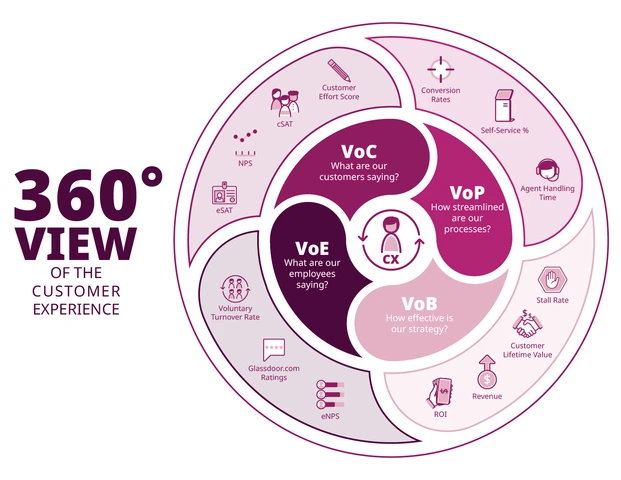
Voice of the Customer: What Customers Say
To understand what happens along the customer journey —from researching a product/service to purchasing, using and managing it—you need to listen. VoC refers to collecting, analyzing and distributing customer feedback to improve a product, solution or service. VoC focuses on customer needs, expectations, preferences and complaints. Many companies rely primarily on VoC surveys and social listening to reveal what customers are thinking, what their intentions are and how they react to different experiences.
In theory, VoC surveys help businesses understand and meet consumer needs and expectations and improve products and services. In reality, VoC data can be misleading. VoC surveys are subject to response bias—people tend to respond inaccurately or falsely to survey questions, whether deliberately or accidentally. Therefore, customer preferences expressed in surveys may not truly reflect their opinions or experiences. According to David Ogilvy, considered the father of advertising, “Consumers don’t think what they feel. They don’t say what they think, and they don’t do what they say.” And that is if they say anything at all.
Understanding customer experience requires knowing the real-time context that led to the customer’s response. Why was the customer dissatisfied with the call center experience? Was there a long wait? Or was the call transferred to three agents, requiring the customer to repeatedly explain the problem? To answer these questions, you have to know not only what the customer said happened, but also the customer actually did. VoC will uncover one side of the story. To piece together the full picture, you need to synthesize this information with research into process, Net Promoter Scores, and customer journey analytics.
Voice of Business (VoB): What the Business Needs
The Voice of Business (VoB)—or the needs, wants, and expectations of business stakeholders—ties customer experience to the long-term success of the organization. VoB data often manifests in financial form—accounting reports, board meetings, top-line revenue, profitability, etc.
How is this relevant to CX? It adds a layer of insight highlighting the ROI of past projects to guide future investments and identify high-revenue-growth areas of the business. For example, if a telecommunications company evaluates VoB and notices the trend that revenue of a customer drops off after their initial promotion ends, this indicates an issue with the promo roll-off experience (or lack of it). From there, the team can begin to generate potential project requirements and relevant KPIs to create a business case geared at addressing this retention issue.
Voice of the Process (VoP): What Customers Do
Valuable customer experience data comes from the Voice of the Process (VoP), defined as the capability of business processes to meet the wants, needs and expectations of VoC and VoB. VoP indicates how well a process meets customer needs by capturing what happens during each step in the customer’s journey. For example, to research electricity plans, consumers must complete several steps: visit their utility company’s website, log in, enter their zip code and view available electricity plans.
The experience may break down during any of those steps (e.g., customer can’t log in or doesn’t understand the plans), generating a call to the contact center. This is where journey analytics adds more insights beyond any VoC survey. Journey analytics refers to gathering data about customer behavior and interactions with a brand across channels to develop a detailed understanding of the underlying journey. These analytics highlight the steps on each customer’s journey, providing insight into areas of friction and pain points, ultimately uncovering causes of customer attrition within in the full context of preceding and subsequent interactions.
Voice of the Employee (VoE): How Employees Influence Customer Experience
Voice of Employee (VoE) is a systematic process designed to uncover and assess employee concerns or problems that impact the total employer-employee relationship. Most employees contribute to the customer experience , either directly (on customer-facing teams) or indirectly (e.g., back-office staff who handle billing). Therefore, it is imperative to collect and analyze employee feedback across employee satisfaction surveys, Glassdoor reviews, social media posts and internal discussion threads. In addition to providing context for the overall experience, employee feedback helps identify areas for experience improvements in processes, policies and technology.
For example, contact center agents may indicate that it takes too long to find the information they need to resolve a customer’s problem. This feedback could inform the strategy of implementing a better software solution that instantly gathers and displays necessary customer data (including what happened during previous customer service interactions). Or if employees indicate that there are too many calls coming into the contact center following a batch and blast send of bill notifications, it might be time for the business to introduce customer journey orchestration to send these notices in a personalized, proactive fashion to all customers to avoid contact center overload. Combining employee feedback with journey analytics and the other voices will reveal areas of optimization.
A Powerful Customer Experience Solution Will Help
Listening to and synthesizing these voices can be tricky and time consuming, but vital. Build a strategic business case and deploy a CX solution that ingests and analyzes VoB, VoP, VoE and VoC data in real time. CSG Xponent was created with this in mind. With this solution, our CX team calibrates quantitative and qualitative assessments of your organization’s customer experience capabilities. This exercise illuminates which customer journey investments will lead to the best ROI in the shortest timeframe. Orchestrating said customer journeys is executed by our CSG Xponent platform, which includes award-winning and industry-leading journey orchestration and journey analytics capabilities. In a matter of 90 days, Xponent Ignite enables you to move beyond simple surveys, evaluating and enhancing all customer interactions with your brand.
Ready to leverage more than VoC surveys? Let's talk.