
One Metric Isn't Enough: CX Is More than NPS
As customer experience (CX) climbs the priorities list at nearly every company, leaders are seeking tangible ways to tie key performance indicators (KPIs) to CX. What is the first metric that brands turn to for evaluating their customer experience improvements? For many, it’s their net promoter score (NPS). NPS quantifies the likelihood that a consumer would recommend Company X to a friend or colleague. The problem with leaning on that metric alone, is that it doesn’t consider the entire customer experience and often omits a crucial follow-up question: “Why?” Instead of using one number to understand a brand’s loyalty and retention, it’s crucial to capture feedback in a variety of ways and throughout the entire lifecycle, from intent to buy to retention of returning buyers.
The Challenge with Focusing Only on NPS
While NPS is valuable to track, it only considers one dimension of loyalty. NPS simply tracks on a scale of 1-10 how likely someone is to recommend a company to a friend at a single point in time, not across the continuum of the customer journey. Does your company know why customers give a high or low NPS score? With a single KPI , it can be hard to make informed business decisions. For example, if a customer leaves a low NPS score via an email survey, it could be because earlier that week they had a bad call center experience. The low NPS score has nothing to do with your online CX and everything to do with their interaction with the call center agent. NPS doesn’t necessarily tell you what to fix , and it can be difficult to understand how to improve. Capturing multiple metrics not only helps you to evaluate customer experience holistically but also ask more specific questions and assess more interactions with your customers over a period of time.
A Different Approach to Customer Feedback
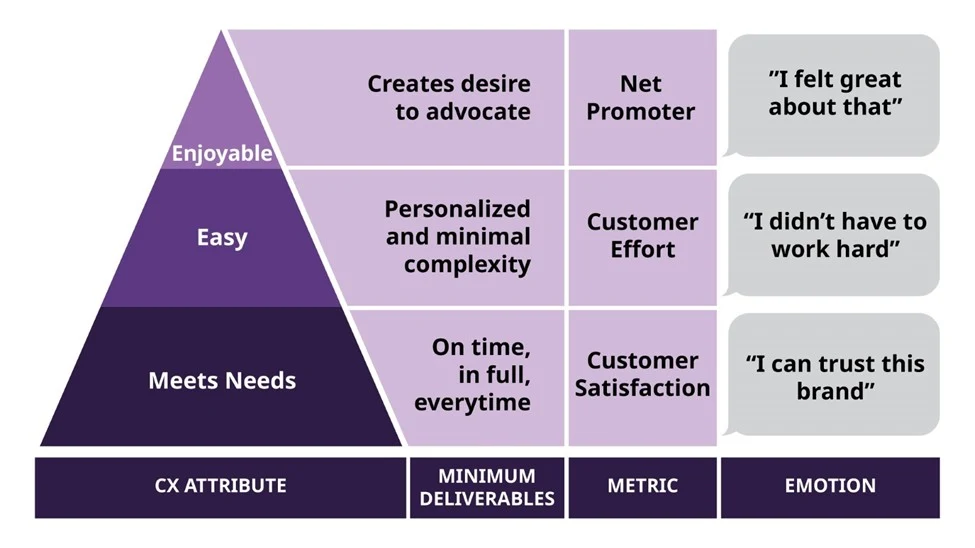
According to the Forrester Customer Experience Pyramid , there are three different ways to measure customer satisfaction and impact customer experience.
1. Meet the Basic Customer Experience Needs
Sixty-six percent of customers expect companies to understand their needs. Similar to Maslow’s Hierarchy of Needs, this is where you first find out what’s important to customers, find out how you’re delivering against it, and then fix the most important experiences first. How do you do this?
Create raving fans from the start — Leverage clear, concise and compelling messaging that makes it easier to connect with your brand.
Communicate transparently — Consumers value brands that lead with authenticity and communicate the good, bad, the ugly and everything in between.
Show up with empathy — We’re all human. Connect emotionally with your customers and show up for them when they need you. For example, the way Chewy sends flowers to customers who have lost their furry friend.
A tactical way to understand customers’ most basic needs is to send a personalized micro-survey to your customer after important interactions. It should ask them why they chose your business and what they’re hoping X product or service will do for them. More than just sending surveys, you should leverage a customer experience management system that will support proactive and real-time communication that reaches customers in their channel of preference in a timely way. At CSG, we start with our customers by identifying their business goals. What are the most important outcomes of working with us? What are the improvements they are hoping to see? From there we help them build a tangible business case for a CX project by identifying where they are today in CX maturity and calculating the project’s predicted ROI. For example, if we know that a telecommunications customer’s largest KPI is reducing call center-related expenses, we create a tactical plan and proven ROI calculation to address that need.
2. Make Customer Experiences Easy & Memorable
How easy is it for customers to do business with you? This is known as a Customer Effort Score, another important metric to track. Measure this by asking customers after an interaction (on a scale of 1 to 10) how strongly they would agree or disagree that your company made it easy for them to handle their issue. Organizations create loyal customers when their customers can find what they’re looking for or solve their issues quickly and easily. Automation and personalization play a huge role in monitoring and reducing customer effort. Where do you start in designing self-service and memorable experiences?
Send personalized offers
Leverage machine learning that is trained and effective instead of a lackluster call deflection bot
Communicate in a timely manner through preferred channels so customers can address their needs more quickly
At CSG, our customer engagement technology helps our customers manage real-time interactions. Our robust journey analytics help users understand how consumers are behaving across the entire lifecycle and amongst different journeys (e.g., acquisition, onboarding, retention, etc.). For example, when telecommunications customers are rolling off an introductory promotion, our technology tracks behavior across all those interactions (e.g., responses to emails, in-app engagement, etc.) and determines the next best action to avoid churn after promo expiration, while also identifying areas where consumers are getting stuck or call volumes are rising.
3. Create Enjoyable Experiences
The third element to evaluate in experience improvement is how strong an emotional connection your customers have with your brand. Advocacy is the main objective here, and this is where NPS does become important. Do they enjoy their experience with you? Would they recommend your business to a friend? To see improvement in designing your CX to establish this emotional connection and make the experience more enjoyable, consider picking the journeys that might be most frustrating for your customers and applying industry best practices to reduce friction points, delivering instead a positive and memorable experience. For example, if a customer experiences credit card fraud, how proactive is your organization in alerting the customer and immediately sending them a new card? Are you reaching them in the channel that they are most likely to respond to, or do they have to discover the fraudulent activity themselves and sit in a call center waiting queue? Identifying journeys where your customers struggle the most can be the difference-maker in creating a positive experience and give you a competitive advantage.
Related Post: Customer Engagement Solutions Drive CX and EX
What to Do with Customer Feedback
So, you have all this customer feedback and data—now what do you do with it to identify areas of CX improvement? Start by thematically organizing the feedback. The right customer engagement solution can do this for you and pull together insights and recommendations for what to improve. Typically, organizations can see a common three or four areas of strength or weakness. From there, prioritize improvement efforts based on areas that will drive revenue or reduce costs. For example, are customers confused about their bill and driving up calls in the call center and therefore increasing costs? It might be time to look at deploying a journey around the billing experience that communicates with them proactively about bill changes and helps them to self-serve via a billing application.
Related Post: Deploy Pre-Built Journeys Through Xponent Ignite
CSG’s Customer Experience solutions can take the hard work out of tracking, understanding, and helping you to improve not just one KPI like NPS, but instead the entire customer experience from intent to buy to retention. We start by helping you to identify the biggest challenges your business is facing, predict anticipated ROI and quickly deploy journeys that will solve customer frustration and make your brand experience memorable. We’re here to help. Connect with us so we can discuss some of your biggest CX challenges and uncover the best path forward that will deliver real business results.