The 4 Things CX Programs Need to Prove in 2025

2024 was NOT a banner year for the customer experience (CX) business.
Forrester’s U.S. CX Index Scores fell again (on average) for the third consecutive year. Over in the UK, 44% of consumers said customer service got worse in the past three years, according to a survey published last year. If you zoom out to a global scale, it didn't look much better: global customer experience only “stabilized” in 2024 after a decline in 2023, according to KPMG.
CX professionals saw these industry numbers, and so did some members of their C-suite. That led to some uncomfortable questions from leadership:
“What about our numbers?"
“Is our CX getting worse, too?”
And finally:
“What are we getting for all our CX spend?”
Make no mistake, the teams that collaborate to improve experiences—CX, marketing, customer care, product, and IT among others—are innovating and making strides in various industries. But they’re struggling to demonstrate the value of those improvements.
That’s a problem, because CX spend will be increasingly scrutinized as revenue pressures increase across industries. Business leadership is no longer taking it as a given that their investments to enhance customer and employee experiences are generating real value—that is, increasing revenue, reducing costs and strengthening brand equity.
That’s why we at CSG are calling 2025 the Prove-It Year in CX. Right now, businesses can take nothing for granted. They need to ground their decisions in the insights they’ve gleaned about customers. They need to maximize the value they’re pulling from their martech stack. And they need to connect CX to business objectives using real evidence.
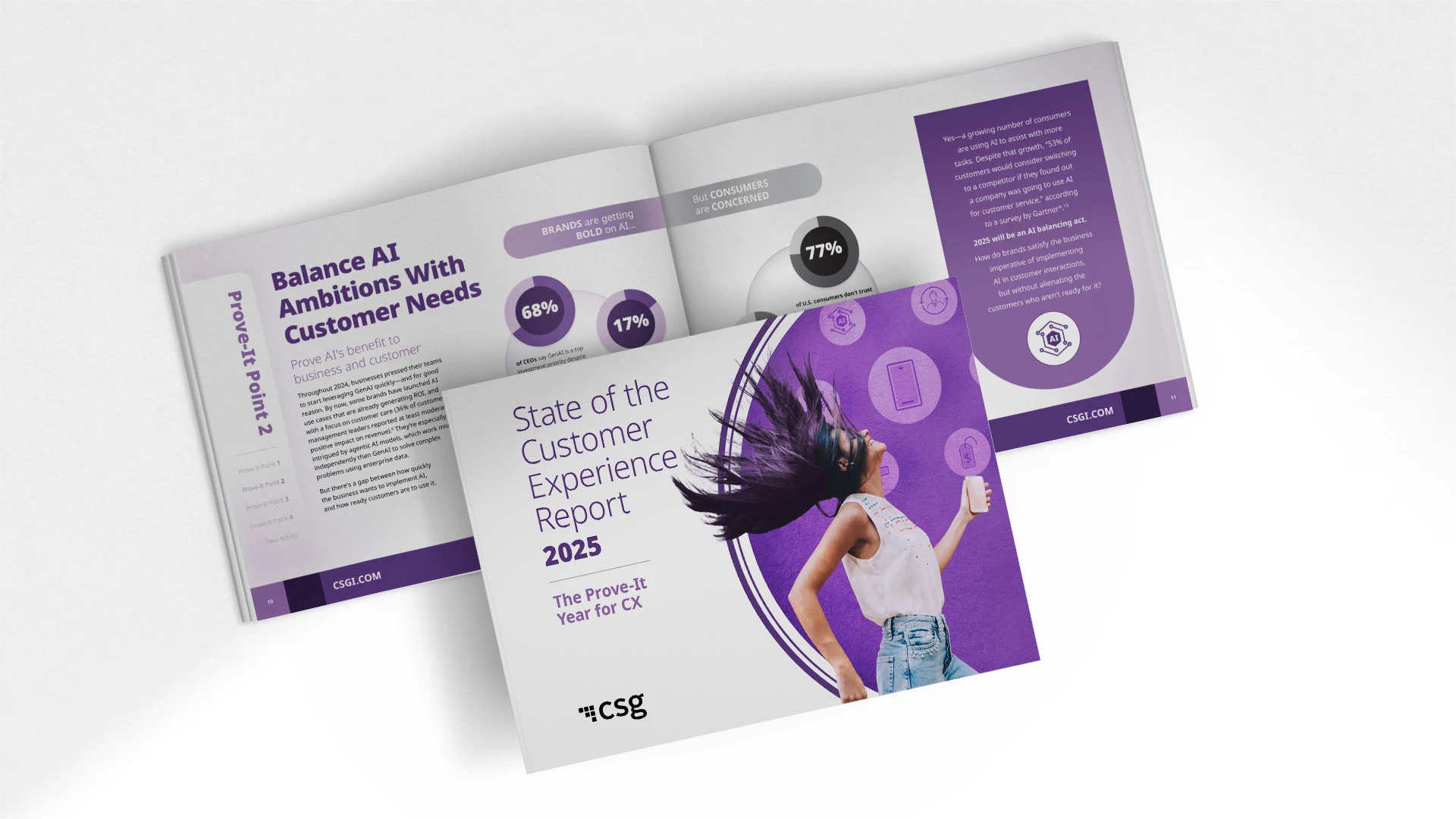
You’ll learn steps for doing all this, and more, in the 2025 State of the Customer Experience Report . Drawing from our conversations with customers and industry analysts, we’ve outlined four definitive ways that leading brands will show their leadership in CX this year.
1. Prove the brand’s promise
As mentioned above, customer satisfaction is stagnating, if not declining. So many businesses aren’t showing up for customers in the way customers expect or demand, so they’re not delivering on the implicit promise of their brand.
The glass-half-empty way of looking at this trend is that it’s a flashing warning light for churn. If you prefer the glass-half-full view, it signals an opportunity to stand out in an underperforming field.
Either way, it should prompt brands to shift their strategy. They're currently falling into the “acquisition trap” —pouring investment into attracting new customers while deprioritizing the ones they have. That deprioritization of post-purchase experiences produces some damaging pain points: frustrating product support interactions, clunky bill-to-payment journeys, and ignored cross-sell/upsell offers, to name a few. These post-purchase pain points increase churn, dampening businesses’ overall revenue growth despite the gains they’re making in acquisition.
How are brands going to fix those “make-or-break" interactions to make their customers feel known, heard and understood?
2. Prove the benefits of AI to business and consumer
In 2024, AI adoption gained major momentum in CX programs. In a recent survey of CX leaders, 73% said investing in CX-focused AI technology is high on the agenda of their C-suite, with 21% saying it is "very high." An IDC study found that 17% of organizations globally have already introduced GenAI-enhanced applications and services into production. Employees are generally buying into using AI at work; in fact, they’re three times more likely to be using AI today than their leaders expect.
But what about consumers? Even as AI applications become more commonplace in their internet searches and mobile phones, it doesn’t mean they all trust a brand’s application of AI.
According to a survey by Gartner, 64% of customers would prefer that companies didn’t use AI in their customer service, and 53% of customers would consider switching to a competitor if they found out a company was going to use AI for customer service.
In 2025, how are CX programs going to satisfy the business imperative of AI—reducing opex and raising revenue—while satisfying customers who aren’t yet ready for it?
3. Prove the value of customer engagement platforms
In last year’s State of the Customer Experience Report , we covered the trend of IT departments taking over the martech stack. Organizations initiated this to make better and more secure use of the mountain of customer data they’re sitting on.
Another objective of the IT collaboration was for businesses to get more value out of their existing technology investments. This is going to be a difference-maker for CX programs in 2025. So many businesses remain encumbered by legacy tools that struggle to keep pace or expand outside their original purpose. As a result, businesses can't get a unified view of their customer insights, which creates disjointed experiences for customers.
How can businesses unlock the customer insights hidden in their legacy systems and drive the most value out of their existing technology?
4. Prove CX's impact to the business
What it all comes down to is showing value, and this is where CX programs often struggle most. They can make the right improvements to critical interactions to strengthen customer loyalty. They can apply AI in ways that meet business directives and customer expectations. They can connect their customer engagement solutions to uncover new efficiencies. But if leaders can’t connect those outcomes to business KPIs, they’ll still meet internal resistance when they try to expand those efforts.
According to Forrester, 60% of CX professionals surveyed said that linking CX to business metrics was a top-three challenge in their VoC/CX measurement program.
How can CX teams translate their traditional CX metrics—CSAT, Net Promoter Score (NPS), etc.—to key business objectives and convincingly demonstrate value?